A dynamic writing by Erik Johnsen
If you enjoy the game of chess, you can also learn about life at the same time, if you see the analogies.
To play the game of chess, or life, means that inevitably, you will have adversaries or opponents.
You are on one side, or the other. Either way, a side is chosen. Also, to play the game of chess, or life, a side has to be chosen. Perhaps the king is represented by your body, mind, and soul. The king is your spirit and your life force, the game is not over until the king, or your spirit and life force, is taken. But so long as the king, or your life force, goes on, the game continues. In the game of life, you choose an adversary, and the game is on.
The king has many pieces at his disposal with which to fight. These pieces are your qualities that make you who you are as determined by your genetics and upbringing: primarily your physical makeup and structure, and your intelligence. Your intelligence consists of your ability to memorize, your ability to piece together information, your ability to calculate, your ability in communication, etc. But, you are a dynamic system subject to change and the pieces at your disposal will change accordingly, over time.
But, what is more important than the pieces at your disposal, is how you choose to use those pieces. How are you going to use those pieces in chess, or
Who is your adversary? Your adversary might not necessarily be another single individual, but it might be a competing group, a competing company or corporation, a competing nation, or an inner struggle you may have within yourself, such as an addiction. Your adversary might also be a goal you are seeking to accomplish, and all of the obstacles that stand in your way, keeping you and that goal apart. Regardless of your adversary, all adversaries have a weak spot - a heart - a life force, where if this life force is cut out, or removed, then the adversary can no longer function, it becomes defunct.
You can expend your resources, trying to eat away at your adversay, but it may take an equal or greater amount out of yourself. Rather than focusing on eating away at the perimeter, or taking away a little at a time, try and focus on getting to the life force of your adversary. This requires more time, involvement, and concentration in contrast to eating away at your adversay, little by little. But focusing in this manner is the wiser path. For example, create diversionary tactics to throw off your adversary, so that your adversary believes you are going in one direction, and they direct their resources in that path, when they are actually creating the opening that you have planned for.
If you try and eat away at your adversary, little by little, it will become easy for them to see what you are doing, and thus your strategy will prove ineffective because your strategy is in plain site of your adversary, all based on how you are choosing to use your pieces.
In general you want to move your pieces towards the opponent's king as fast as possible while at the same time trying to keep your opponent's pieces as far away as possible from your king. One strategy is to keep your king in close proximity behind your other pieces, using your king as an effective piece to back them up, just as long as your are pieces are close enough to jump in easily and protect the king if necessary. If you see your opponent's pieces gradually moving closer to your king, it is a bad sign. If you are having trouble moving your pieces towards your opponent's king, you need to try harder.
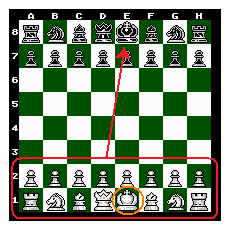
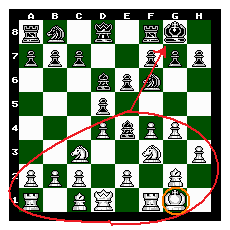
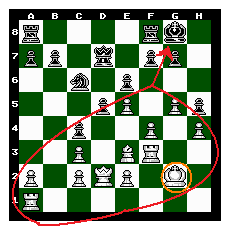
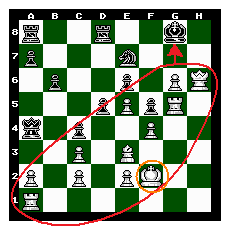
Notice in the above figures that white is advancing his pieces toward the enemy king while using his own pieces as a barrier for his own king.
Destroy Pawn Barriers Protecting Enemy King
One key is to try and blow away any pawn barriers in front of the enemy king. Once this is done, a big part of the offensive strategy is complete. Then the other enemy pieces have to try and compensate for the defensive positions the pawns had, turning some enemy pieces more into defensive ones than offensive, while you can keep all your pieces offensive and continually advance them towards the enemy king. Perhaps even pinning lower pieces against greater ones.
Think Offensively
Always think about making an offensive move before a defensive one. It is better to be on the offense rather than defense. You want to have an attacking mentality, not a retreating one. The attacking mentality will help you win the game, the retreating mentality will help you lose the game.
Flip an Attack on You
Sometimes defensive maneuvers must be taken to avoid losing certain pieces, but sometimes if an opponent puts an attack on your piece, you can flip that attack and return a more threating attack.
Use the Rooks
The rook can be a crucial component to your success, but usually it is stuck behind pawns. If it can be freed early in the game, before your opponent has a chance to free his rooks, then it can allow you the upper hand. Usually this means castling, or moving pawns out of the way.
Don't stack pawns
It is best to avoid stacking the pawns vertically, this can block your pieces and allow openings for your opponent.
Never underestimate your opponent
If you pull a trick on your opponent early in the game, and it appears as if you are closing in on him, still always look at all your opponent's possible moves, because they might surprise you.
Avoid Moves That Could Result in a Loss of a Move
if you are opening the game, and you can move a piece where a pawn or lower piece can attack, which will force you back, then there typically isn't much point in moving there. This usually means you in a sense lose a move while the enemy has advanced a piece forward.
Letting Enemy Attack First May Help You Gain Position
When it comes to trading pieces, sometimes it's best to let the enemy attack first. You see, he attacks you, by advancing a piece of his forward, but then you return capture on him, by advancing your piece forward. So in the end, you have a piece forward. If you attack first, by advancing a piece forward to capture, then the opponent will advance his piece forward capturing your piece. So in the end, the enemy has a piece forward.
Pinning
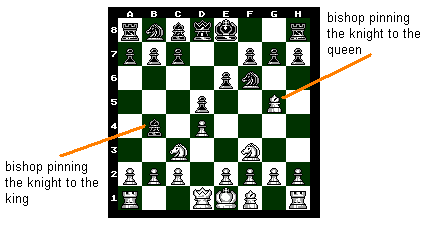
Get Your Enemy to Stack His Pawns
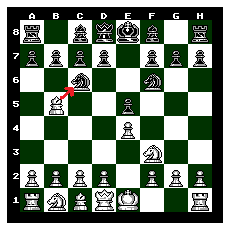
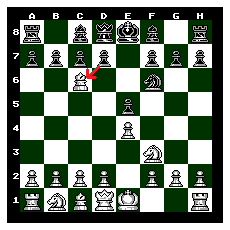
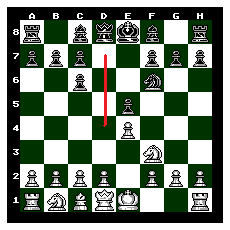
If black wants to get the bishop after taking his knight, black has to take with the pawn. This allows an opening for white through blacks pawn defense.
Pawn Up Along the Enemy's Double-Pawned File
The pawn that is along the enemy's double-pawned file, make sure that pawn is at least one square ahead of the pawns to its side. This will keep the enemy from inching up the first pawn along the double pawned file to an enemy pawn so the enemy can un-double his pawns, eliminating your advantage.
Sometimes Castle Can be Viewed as a Loss of a Move
Sometimes you have the momentum going in a certain area when a castle really isn't necessary.
Being Reactive
Being reactive by equivalency is not a strategy - it is just losing. For example, if your boss gets lippy or smart-mouth with you and you do the same back, you just put yourself in a losing position. In chess, if you make the same moves as your opponent, you will only lose. An eye-for-an-eye is losing.
Misc
from the very start of the game, before you even move too many pawns, you need to think about protection for the king. What kind of protection is the king going to have later in the game? So maybe you think about a row of pawns either on the left side or right side and how you can castle behind them later. So think about that before getting too eager and moving too many pawns forward.
One idea is to move the pawns forward and to force your other pieces up behind to reinforce them, to let the pawns take the brunt of the impact, rather than putting your more important pieces on the front lines. So think about how you can move the pawns forward while keeping the other pieces closely following behind.
So later in the game you get your king behind a row of pawns, well then you want to force those pawns forward, but bring in the other pieces to fill the void between the kind and the pawns that were protecting him. So that you form a two-tiered barrier between the king and the enemy. The first layer being the pawns and the other layer being the more important pieces.
As you create this two-layered barrier to protect the king, at the same time you are pushing this barrier towards the enemy, because with the limited pieces of chess, the defense and offense must act as one.
So you push your barrier protecting your king towards the enemy's king.
The trick is, how are you going to break through the enemy's barrier? Sometimes it means an initial sacrifice. But if that sacrifice is say at the cost of one pawn. The payoff can be you checkmating the enemy king.
One thing I like to do is if the enemy castles, the king is trapped in one corner more or less. So I push up towards the king with pawns, and use a sacrificial pawn to create an opening or void straight to the enemy king.
Then I try to use that void to funnel in my pieces through to the enemy king.
If you get to the enemy king before the enemy gets to your king, then they wind up using their resources for defense while you are using yours for offence.
Sometimes it cascades where you end up rallying the bulk of your pieces in all for offense and in response the enemy ends up using the bulk of their pieces for defense, so it ends up working in your favor.
The key is you need to get to the enemy king before they get to your king.
For the pawns protecting the king, if push one of those pawns forward, you need to very quickly bring in a non-pawn reinforcement piece behind that pawn protecting the king.
The enemy might move in such as way to open up a hole on your side. You must avoid this at all costs.
Sometimes, in preparation for an attack, if it's early enough in the game, I try to bring in pieces as they are naturally at the sides, I try to bring them in and consolidate them into a core grouping more or less. And prepare them for a direct straight line attack across the board to the enemy king.
The important thing is that in preparation for breaking through the enemy barrier, that you have mulitiple lines of attack reserved towards the enemy king.
need to move your pieces close as possible to opponents king
need to get your pieces close to the opponents side as quick as possible
sometimes it's better to let the opponent attack first, cause after you attack back you will have better controlling position on board
while you move pieces to opponents side, it's also important to create an opening of some sort to route all your forces in, to break through opponents defensive barrier